WhatsApp chatbots3 min read
WhatsApp bot or AI chatbot? Why ours deliberately isn't an AI
When a UAE business should use a rule-based WhatsApp bot, when an AI chatbot is worth it, and why the bot in SARZ Command deliberately isn't a language model.
Published 23 October 2026Last updated By Muhammad Raza
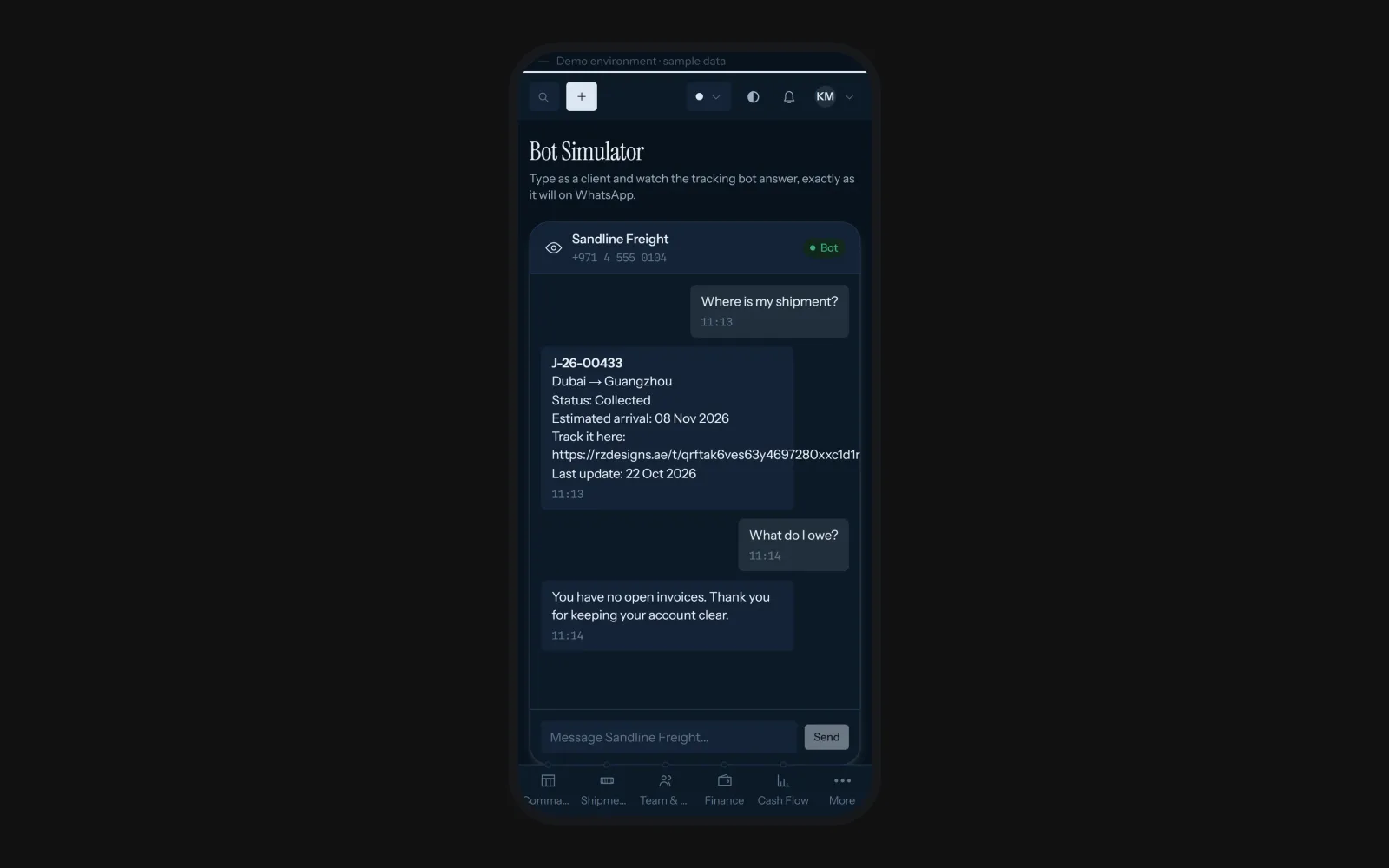
For questions about a customer's own order, invoice or booking, use a rule-based WhatsApp bot that reads your records: it gives the right answer every time and can't make one up. Use AI only for open-ended questions (products, policies, "do you do this?"), and only from content you control, with a clear hand-off to a person. Most UAE businesses need the first, and many are sold the second.
The WhatsApp bot we built into SARZ Command is deliberately not a language model. Here's why, and when we'd choose AI instead.
What the customer is really asking
Look at what customers actually message a business about. Most of it falls into a few questions:
- Where's my order or shipment?
- What do I owe? Can you send the invoice?
- Can you send my documents?
- I need a quote.
- Can I talk to someone?
Each one has a single correct answer that already exists in your system. A bot doesn't need to be creative to answer it. It needs to look it up and reply in under a second.
How the SARZ Command bot works
The bot recognises six intents: menu and greeting, track a shipment, my invoices, my documents, get a quote, and talk to a person. It identifies the client by the number they're writing from, so it only ever returns that client's own shipments, invoices and documents. Clients never log in.
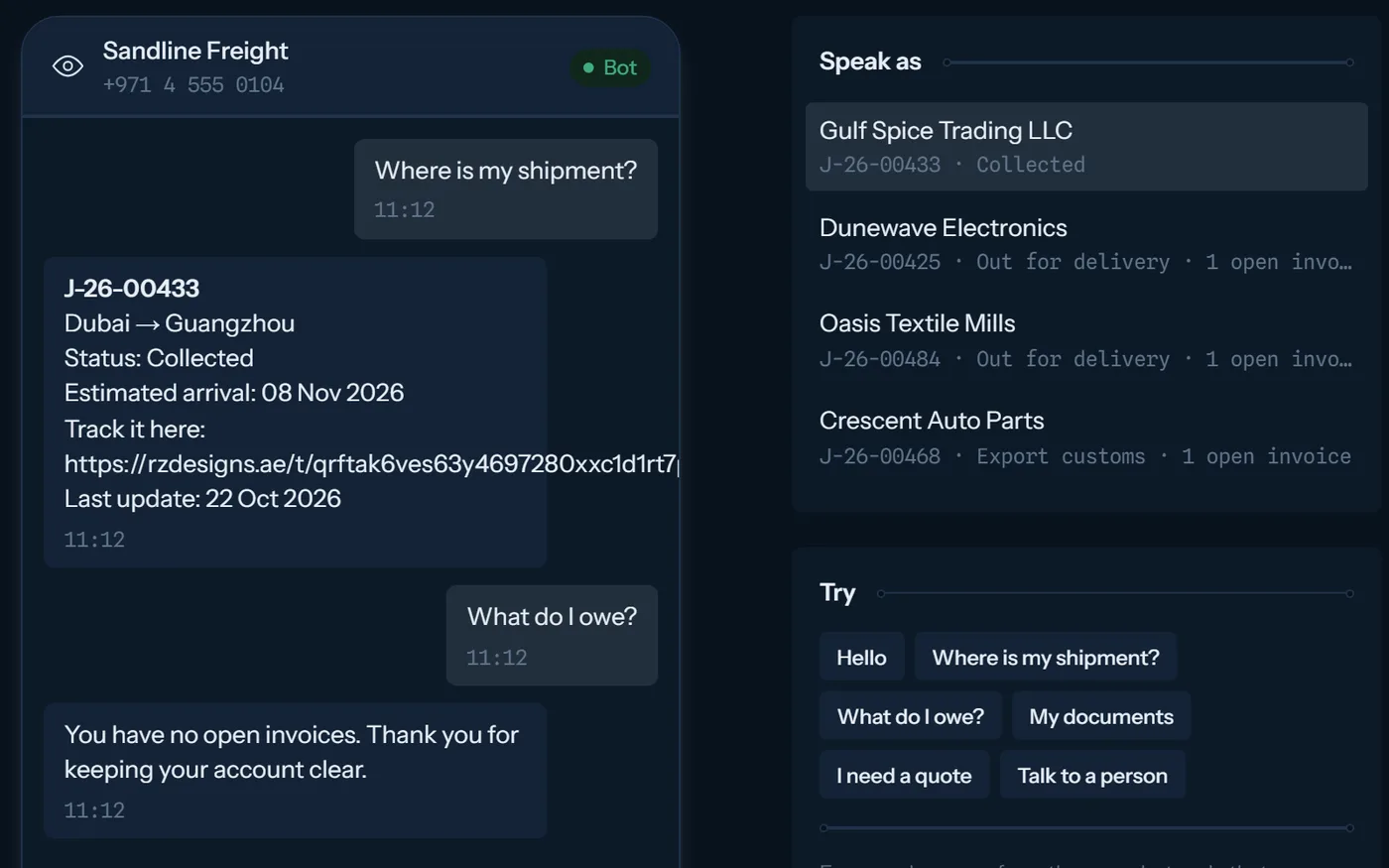
Because it isn't a language model, a client asking where their cargo is gets the real stage and ETA every time, with no chance of an invented tracking number. A quote request becomes an enquiry in the sales queue, and "talk to a person" hands off to the assigned rep. You can see it in the cover image: a real conversation from the system, with sample data.
Where AI goes wrong in customer service
Language models are very good at sounding right. That's the problem when the answer has to be right. An AI bot asked "when will my order arrive?" can produce a confident date that isn't in your system. Asked about a refund policy, it can describe one you don't have. Each of those is a customer who now distrusts you, or a promise your team has to honour.
When AI is worth it
AI earns its place when the questions are open-ended and the answers don't depend on the customer's account:
- Product discovery: "which one is better for a small office?"
- Long FAQs: delivery areas, warranties, how a service works.
- Understanding messy messages and routing them to the right flow or person.
Even then, the AI should answer only from content you've approved (your FAQ, product pages, policies), say when it doesn't know, and hand off to a person easily.
The best of both
The setup we recommend for most UAE businesses is a hybrid:
- Rules for anything about the customer's account: orders, invoices, bookings, documents.
- AI, optionally, for general questions, answering from approved content only.
- A person for everything else, with the conversation history attached so the customer never repeats themselves.
What it costs to run
Every WhatsApp bot pays Meta's message pricing for templates (see our WhatsApp Business API guide). An AI bot adds AI usage on top: Meta prices its own Business Agent messages by tokens, and third-party AI is billed separately (Meta pricing). A rule-based bot adds no AI cost at all.
Want a WhatsApp bot that answers from your own data? See WhatsApp chatbots, or book a SARZ Command demo to see this one working.
Questions, answered.
Should my WhatsApp chatbot use AI?
It depends on the question it answers. For questions about a customer's own order, invoice or booking, a rule-based bot that reads your records is safer, because it can't invent an answer. AI is worth it for open-ended questions about products or policies, as long as it only answers from content you control.
What is a rule-based chatbot?
A bot that recognises a set of intents, such as tracking an order, checking what's owed or asking for a quote, and answers each one from fixed logic and your own data. It gives the same correct answer every time and hands anything else to a person.
Can an AI chatbot give wrong information?
Yes. Language models can produce confident answers that aren't true, such as a delivery date, a price or a policy. That's why we keep anything about a customer's account in rule-based flows, and limit AI to answering from approved content with a clear hand-off to a person.
Does an AI chatbot cost more to run on WhatsApp?
It can. On top of WhatsApp's message pricing, AI usage is billed separately, and Meta prices its own Business Agent messages by tokens. A rule-based bot has no AI cost at all.
More insights.
WhatsApp chatbots4 min read
WhatsApp Business API in the UAE: costs, providers and setup (2026)
How the WhatsApp Business API is priced in the UAE since Meta's per-message model, what's free, what changed on 1 October 2026, and how to set it up.
22 October 2026

E-commerce3 min read
Headless Shopify: what it is, and when a UAE brand actually needs one
What headless Shopify is, what it costs you in build and upkeep, and when a UAE brand should choose it over a theme, from a real headless store we built.
23 October 2026
Email marketing3 min read
The Klaviyo flows to set up first on a Shopify store
The Klaviyo flows a Shopify store should set up first (welcome, abandoned cart, browse abandonment, post-purchase and winback) and what each email should say.
23 October 2026